From Dashboards to Agents: The Evolution of Enterprise Decision-Making
How AI is closing the gap between insight, decision and action
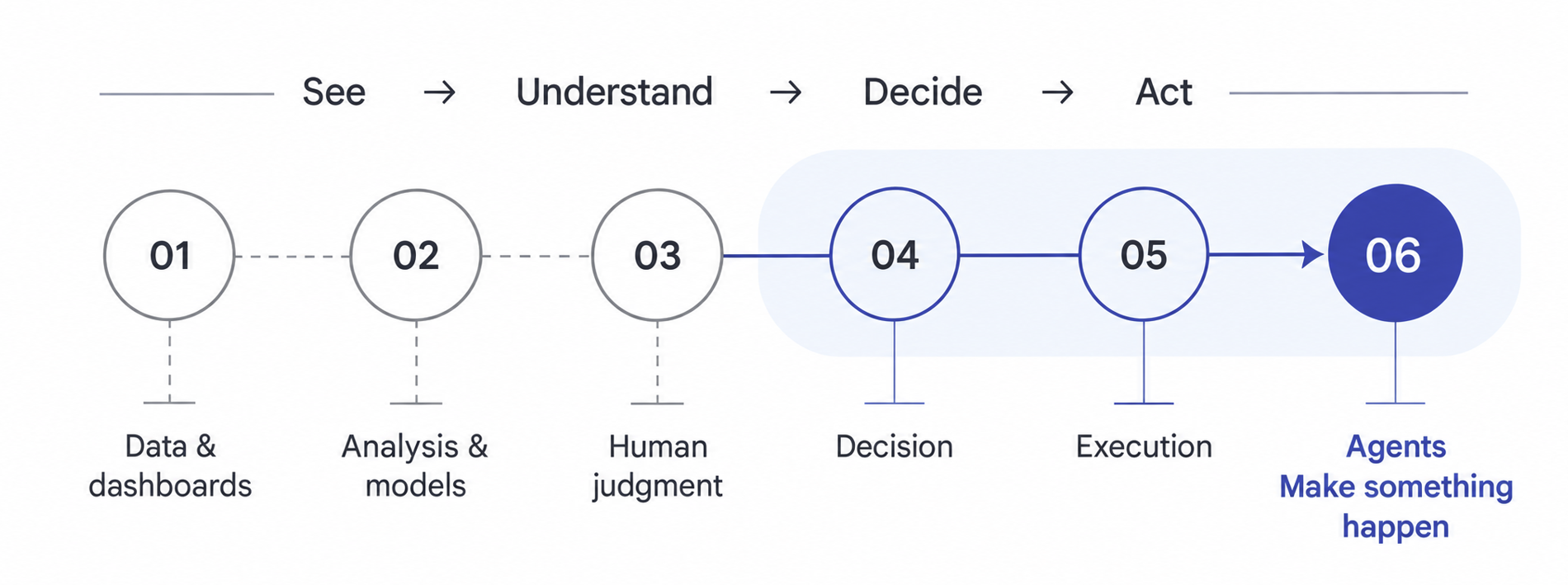
For many enterprise decisions, there have traditionally been several layers between a signal and an action:
Data & dashboards → Analysis & models → Human judgment → Decision → Execution
Now imagine some of these layers coming together with AI.
Instead of a dashboard simply telling you that something changed, an AI system could increasingly understand what changed, why it may have happened, what options are available, and what action to take.
Let’s look at this shift through three very different examples: ecommerce, an AI recruiter conversation, and patient treatment gaps in healthcare.
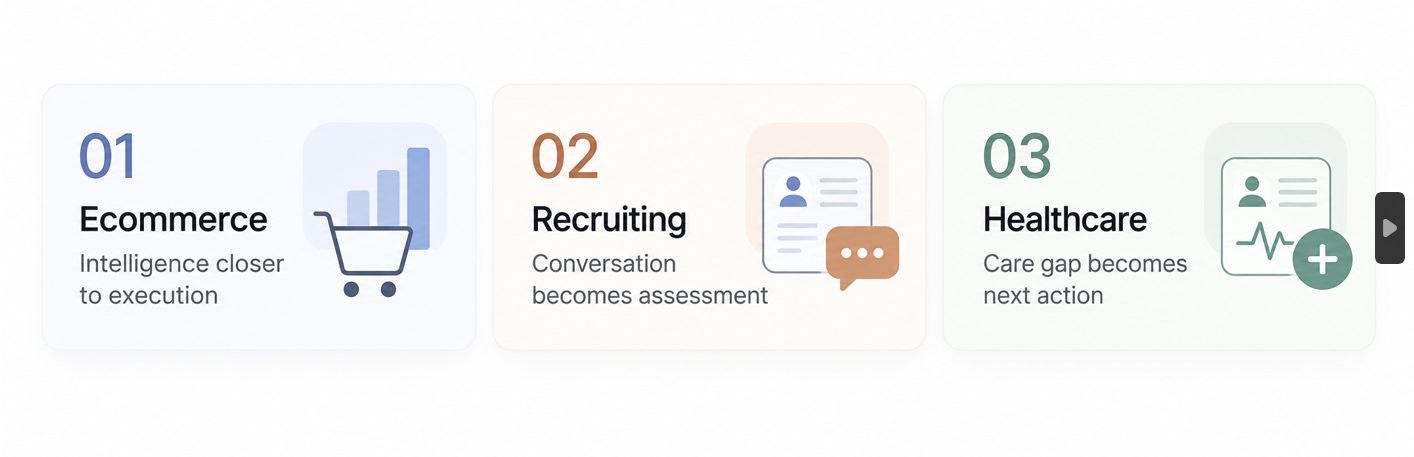
Ecommerce
Think about how a large ecommerce business manages thousands of products across multiple retailers.
There are dashboards for sales, inventory, pricing, media and digital shelf performance. There are analytics and ML models generating insights and recommendations. There are analysts, category managers, agencies and business teams interpreting those signals and deciding what to do.
But someone still has to connect the dots, decide what matters, and execute the next action.
And this is where AI is beginning to shift the dynamics.
CommerceIQ is one example of a company moving in this direction - bringing ecommerce intelligence closer to decision-making and execution.
This is the shift from dashboards to agents that I find interesting.
I recently experienced this during a 35-minute AI recruiter call
Instead of simply collecting my resume and asking a standard set of screening questions, the AI recruiter explored my experience, referred to technologies I had worked with, and asked follow-up questions about my experience building AI products.
What stood out to me was that it wasn't simply retrieving information from my resume.
It was referring to my resume in real time, interpreting my responses, probing further and forming an assessment based on the conversation.
A process that traditionally involves a recruiter reviewing a resume, forming a hypothesis, conducting a screening conversation and deciding whether to move a candidate forward was being partially compressed into an AI-driven interaction.
What is changing?
What is changing is not simply that enterprises now have GenAI.
For years, AI and ML have helped businesses predict, score and recommend. What is different now is the ability to bring together data, context, existing intelligence and enterprise systems - and increasingly connect them to action.
GenAI can help understand context and unstructured information, while agentic systems can orchestrate multiple steps and interact with the systems where work happens.
The result is a shift from technology that primarily helps people see, understand and decide toward systems that can increasingly understand, decide and act.
And I am seeing this shift show up in very different kinds of work.
I have also witnessed this from the product side in healthcare
I was exploring a Care Gap AI Agent designed to identify gaps in patient care and help translate those insights into action.
The challenge wasn't simply finding a care gap.
It was bringing together patient information, quality measures and clinical context, and then helping determine what should happen next.
The goal was to move from:
“There is a care gap.”
to:
“Here is what should happen next.”
That difference matters.
An AI system becomes much more useful when it can participate in what happens after the insight.
The bigger shift
These are very different use cases - ecommerce, recruitment and healthcare.
But the underlying pattern is similar.
Enterprises have spent years building dashboards, analytics, ML models, business rules and specialized teams to help people gather information, interpret it and make decisions.
AI is beginning to compress the distance between these steps - and, in some cases, the distance between decision and execution as well.
I don't think every decision should become autonomous. Some decisions are too consequential, ambiguous or difficult to reverse.
But there are many decisions and workflows that happen frequently, follow recognizable patterns and consume significant human effort.
These may be some of the first places where AI can take on more responsibility.
The interesting question is no longer just:
“Where can AI generate an insight?”
It is:
“How far can that insight travel into the actual workflow - and what should AI be allowed to do once it gets there?”
Perhaps the next generation of enterprise systems won't just tell us what happened, explain what might happen, or recommend what to do.
They will increasingly help make something happen.
That may be the real journey:
From dashboards → to intelligence → to decisions → to action → to agents.